About NEXPLANON®
NEXPLANON® is a sub dermal contraceptive implant that lasts for up to 3 years and is over 99% effective1
Indication: NEXPLANON is for contraception. Safety and efficacy have been established in women between 18 and 40 years of age
NEXPLANON is a method of long-acting reversible contraception (LARC).1
Progestogen only
Containing only the progestogen etonogestrel,1 NEXPLANON is suitable for a wide range of women. The most recent UK Medical Eligibility Criteria for contraceptive use should be used when assessing a woman’s eligibility for any contraceptive method including the progestogen-only implant.2
The efficacy of NEXPLANON is over 99% for up to 3 years.1 NEXPLANON primarily works by inhibiting ovulation.1 During the clinical studies no pregnancies were observed during 35,057 cycles of exposure; the Pearl Index observed is 0.00 (95% confidence limits: 0.00-0.14). However, it must be realised that in practice no method can be considered 100% effective. The high degree of protection against pregnancy is obtained, amongst other reasons, because the contraceptive action of NEXPLANON is not dependent on adherence to a dosing regimen by the woman herself.1
Reversible
The contraceptive action of etonogestrel is reversible, which is apparent from the rapid return of the normal menstrual cycle after removal of the implant.1 Return of fertility depends on age and pre-implantation fertility levels.3
Etonogestrel is rapidly eliminated following implant removal4
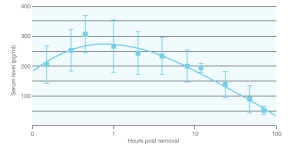
Adapted from Davies 19934
It has been shown that ovulation is inhibited at serum etonogestrel concentrations of above 90pg/ml4
Study Design of Davies (1993)
- The properties of a single contraceptive subdermal implant releasing 3-ketodesogestrel were assessed in fifteen women over twelve months.
- Serum levels of 3-ketodesogestrel (3-KDG) were monitored regularly following insertion and after removal. The aim of the study was to investigate the release characteristics, the effects on ovarian activity and menstrual bleeding over a twelve-month study period, representing the second year of use.
- The implant was inserted between day one and five of the menstrual cycle. Immediately prior to insertion of the implant, an indwelling venous catheter (Venflon) was inserted in the opposite arm. Following implant insertion, blood samples were taken from the catheter at 0.25, 0.5, 0.75, 1, 2. 4, 8, 12, 24, 48, and 72 h for 3-KDG estimation. The 3-KDG analysis continued at 30-day intervals. Immediately after insertion and at six-month intervals, each volunteer entered a period of intensive monitoring. During this time, USS and endocrine assays were performed twice a week for six successive weeks. A sample of mucus was taken once in each 6-week period and an lnsler score and sperm mucus interaction test performed. The blood pressure and weight were measured. If a follicle persisted after six weeks, these volunteers were followed-up by USS and endocrine assay until the follicle resolved. During the study each volunteer was asked to keep a diary of her bleeding pattern. Before removal of the implant, a full physical examination was performed and a Venflon catheter inserted in a vein in the opposite arm. After removal of the implant, a similar sequence of 3-KDG samples as at implantation were collected from +0.30 h to +72 h. Ultrasound scanning and endocrine assays were performed twice per week for a minimum of six weeks or until ovulation and/or menstruation occurred.
 Each single, flexible rod releases a continual daily dose of the progestogen etonogestrel for up to 3 years.1
High rates of continuation
High continuation rates at 1 year – around 80%.5
Cost-effective
Cost-effectiveness studies in the UK have reported all currently available LARC methods, including NEXPLANON, to be more cost-effective than oral contraceptives even at 1 year of use.6
References
- NEXPLANON 68 mg implant for subdermal use – Summary of Product Characteristics.
- Faculty of Sexual & Reproductive Healthcare (FSRH). The UK Medical Eligibility Criteria for Contraceptive Use. Available from https://www.fsrh.org/ukmec/.
- Glasier A. Contraception 2002; 65(1): 29–37.
- Davies GC et al. Release characteristics, ovarian activity and menstrual bleeding pattern with a single contraceptive implant releasing 3-ketodesogestrel. Contraception 1993; 47(3): 251-61.
- Trussel J. Contraception 2011; 83(5): 397–404.
- NICE Clinical Guideline 30. Long-acting reversible contraception. London.
Many studies referenced here are about IMPLANON. NEXPLANON is bioequivalent to IMPLANON.
Supporting documentation
Prescribing Information | Summary of Product Characteristics | Patient Information Leaflet
By clicking the above links you will leave the Organon website and be taken to external websites.

